Are You Still Changing Your Mindset?
Jewels Lamm | JAN 3, 2025
mindset
nervoussystem
notgoodenough
feelingstuck
notmovingforward
feelingfear
Are You Still Changing Your Mindset?
Jewels Lamm | JAN 3, 2025
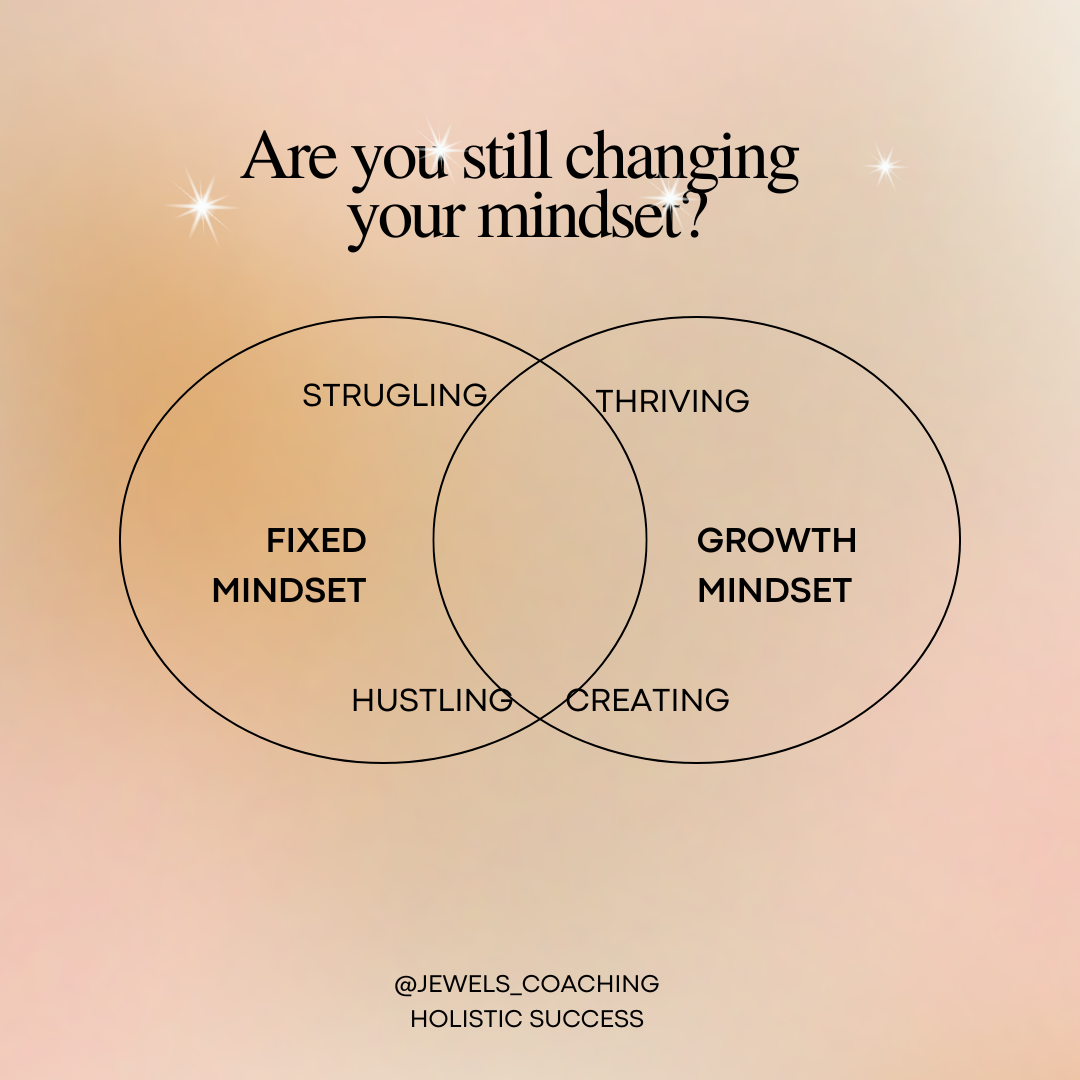
ARE YOU STILL CHANGING YOUR MINDSET?
How is it working for you?
Is it actually working?
Or perhaps, you think it is working because you are
determined to make it work and it gives your Doer part
something to do because it is used to doing and it feels familiar?
Well, if you continue reading it, you might be curious?
Or your Doer part might be feeling triggered: “How dare are you…..?”
All of you is welcome on the journey of exploring this topic with me today:
Is it one causes the other? Which one?
What comes first?
Is it the mindset ?
Or
Is it emotions ?
It is like the chicken and egg problem as it is defined in the Cambridge
dictionary: a situation in which it is impossible to say which of two
things existed first and which caused the other one.
Just like you, I spent many years writing affirmations and diligently changing
my mindset in order to feel a certain way and accomplish certain things and
fit in in the "positive" mindset culture, which only reinforced my "wounds".
It never lasted long term. When I left my coaching sessions with my mindset coach,
I felt inspired to follow through the strategies and take actions but the next day, I felt…
like I always felt - deflated, small and scared. And, if I may add: I felt like a failure because
I failed my coach and my commitment to myself and my vision. In addition to that,
I shamed myself for feeling that way.
I kept building a pyramid that consisted of the same blocks that kept me stuck and feeling
discouraged. That pyramid wasn't very grounded and stable and it finally collapsed.
Do you have a story of your Mindset Transformation?
Would love to hear it.
Essentially, my mindset strategies were all about changing my “negative” mindset that is
often referred to as “fixed” mindset to a more “positive” mindset and often referred to as “growth” mindset.
But, what if how you think is not what is causing the problems you seek help for.
If you are feeling lost, discouraged and stuck in “shoulding all over yourself”, then you are in the right place.
I’ve been there as well. It helped me get out of the “mindset” circles and start looking
around for a more effective explanation of why my thinking was more ‘negative” oriented
compared to my husband’s - “positive” oriented. Do you know those people?
To have a growth mindset, YOU HAVE TO GROW IT.
You cannot just turn it off or on. You cannot just choose to have a growth mindset.
I’ve been trying for 25 years because I’m married to a man who has a growth mindset.
Let’s explore some possible reasons:
Is it how they were raised?
Chemical imbalance, perhaps?
Mental health disorders? Illness?
Trauma?
This is how they were born? Is it in their DNA?
Cultural background?
What if the underlying issue for this “negative” vs “positive” and “fixed” vs “growth”
mindset is in the way that we approach it as either right or wrong; good or bad?
I do not find this approach super helpful. Getting people to think differently is not easy,
especially if that is your primary way of addressing someone’s presenting problems.
One’s thinking does not exist in a vacuum.
What we want to change about ourselves is never just a thinking problem.
There is always more to it.
Have you ever experienced a moment when you felt like you were in flow?
Have you had a day when things were easy and you felt okay?
Have you ever felt joyful, happy, relaxed and at ease on vacation?
Have you ever felt empowered and inspired after hanging out
with your friend who makes you feel safe, connected and abundant?
When you feel safe, connected, in flow, relaxed and joyful, what are your thoughts?
How do you perceive yourself, others and the world?
Have you noticed it?
Notice what happens after you spend some time with your grand kids or dogs or when
you play your favorite game or dance (me)? Don’t you feel different? Notice your thoughts.
Most likely, you naturally have a “growth” mindset during those moments?
It is your nervous system that shapes these experiences.
When your nervous system is regulated, you come into balance with a
sense of stability, connection, safety and harmony.
I assume you feel this way or that your mindset changes, probably when you feel calm,
relaxed and connected to the present moment. In the end of our somatic session today,
I asked my client what allowed her to change her story of fear and shame that she felt in
the beginning of our session. She answered: “My body felt relaxed and I was able to see a
more loving way to handle a challenging situation”.
The purpose of a somatic session is to help my clients titrate their nervous system so
it gets settled to their state of safety, connection and ease.
When that happens, the body feels relaxed because it doesn’t
feel stuck in the survival state of the nervous system.
When that happens, the body relaxes because it does not feel a ‘need” to “protect”.
And……. Yes, the mindset shifts like magic.
My clients often perceive their challenging situations from a completely
different angle because they access their conscious mind where creativity lives.
It does not just come from their mind but they feel aligned in their body.
The point is that there are probably contexts in your life where you already
have a growth mindset or something similar to one.
So, why would it be there in some contexts but not others?
When do you have a fixed mindset?
I am guessing it is probably
when you are more emotionally upset, not calm, or not connected to the present moment.
I would guess it is probably when you are feeling more alone or rejected, and
I would guess it is probably when you are feeling pressured.
Your emotional state has a lot to do with whether you have a fixed or growth mindset.
I do not think one has either growth or fixed.
Perhaps, it is a spectrum from fixed to growth.
Your emotions influence your mindset on the spectrum, but the intensity of your emotions does as well.
When you are mildly frustrated, you probably lean toward a growth mindset (hope).
As you get increasingly frustrated, your mindset probably leans toward fixed (hopeless).
According to the Polyvagal Theory developed by Dr. Stephen Porges, we know that 80% of
information comes from the body that is constantly scanning for the cues of danger or safety.
When your brainstem neurocepts you are in danger, it shifts your body’s state to sympathetic
flight or fight. In this state, your body is activated and cannot settle down and relax.
Your emotions will be anxious, irritated or worried.
And, your thoughts will focus on potential “dangers” (perceived dangers)
like work stressors or past interactions with people based on your stored “bank” of your life experiences.
On the other hand, when your body neurocepts safety, it will shift your body’s state accordingly.
Your thoughts will be hopeful, and you will be more focused. You will have a greater potential for a growth mindset in this state.
YOUR MINDSET POTENTIAL CHANGES DEPENDING ON
THE STATE OF YOUR BODY.
So, your mindset comes from your body’s state,
but your state shifts based on factors from several sources:
environment, interpersonal, and intrapersonal. Each of us will experience these
factors differently, and how things will affect us is not always predictable.
The most influence that we experience comes from our caregivers.
Our relationship with our caregivers, lack of support influence our
copying mechanisms that show up in our adult years.
Trauma experience can severely limit someone’s potential for safety.
In my case, I never experienced a sense of safety until I got 51.
I didn't even know that because I perceived that my hustling and anxious energy was “normal”.
I also did yoga and meditation but feeling still was somewhat not "normal" for me probably because
I was living in a state of shut down. Feeling "normal" did not actually feel safe in my body.
Trauma is not the events or lack of events someone went through but it is the
impact of those events on their bodies. Trauma is being stuck in a defensive state where I spent most of my life.
This defensive state is a state of self-protection.
Trying to change your mindset while you are in a defensive state is likely to reinforce that state -
“I knew I couldn’t do it”. It is just not as simple as changing your thoughts.
Have you tried to convince yourself not to be anxious
while your body was feeling anxious?
How did that work for you?
Did it increase or decrease your anxiety?
People with a growth mindset have a pretty good anchoring in their safety state.
They have a lot or enough access to their safety state (capacity to hold a state of regulation or zone of tolerance).
When obstacles occur in their lives or if they have a failure, they do not sink deeply into defensive state activation.
They can roll with what life throws at them because their safety state is strong enough, resulting in higher distress tolerance.
That is exactly how I would describe my husband.
I know I understand why two people who experience the same event
have a completely different experience/reaction to the events.
It is because of the nervous system they are in.
My perception of myself, life and people (hopeless, doomed, cursed)
was very different when I was in a state of shutdown.
My perception of myself, life and people has changed completely
as I've expanded my capacity to feel safe with loving myself, people and life (current state).
The growth mindset person did not wake up with a growth mindset.
It was fostered and developed along with continual safety state.
Their capacity to tolerate grew on an autonomic level and then their thoughts followed.
We all have capacity to growth our zone of regulation and flexible nervous system
that we can use to navigate our life experiences by moving through all the states available to us.
In conclusion, a fixed mindset is not a problem.
Feeling stuck in a survival, defensive state of the nervous system is the primary problem.
I was definitely stuck there. I am a living example of being a person
with all the attributes of a fixed mindset (negative).
When I started to work with my nervous system and learn a somatic language of my body to
help me release my stuck states of survival, I started naturally
experiencing a state of joy, connection and safety.
This state is not familiar to my nervous system so I continue to grow my capacity
to feel safe feeling joy, connection and safety.
I believe we spend too much time and energy changing our thoughts and stressing
about getting our mindset “right” without addressing the route cause.
There is value in being aware of your thinking, narratives and stories.
But there is more value to what’s happening underneath your thinking - the stuff you are
probably unaware of - your unconscious life history lives in your body.
That is why I use trauma-informed somatic guidance to help my clients to access
their unconscious, discharge and complete their body’s survival responses to grow
their capacity to hold all the spectrum of their emotions with safety just like the
ocean that holds all variations of the waves without "fixing" some at the sake of others.
I invite you to be more curious about what life history your body is holding
and protecting you from experiencing and how it is influencing your current state of creation.
If you want to experience a complimentary somatic session, reach out.
Jewels
Jewels Lamm | JAN 3, 2025
Share this blog post
 OfferingTree